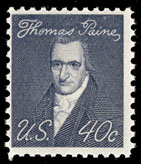
), 1793
Thomas Paine: 264 citations1 J'aime
Thomas Paine Citations
Thomas Paine: Citations en anglais
An Essay on the Origin of Free-Masonry (1803-1805); found in manuscript form after Paine's death and thought to have been written for an intended part III of The Age of Reason. It was partially published in 1810 and published in its entirety in 1818.
1800s
“It is error only, and not truth, that shrinks from inquiry.”
The complete political works. Rights of man: being an answer to Mr. Burke's attack on the French Revolution, p. 306
1790s
1790s, First Principles of Government (1795)
Contexte: An avidity to punish is always dangerous to liberty. It leads men to stretch, to misinterpret, and to misapply even the best of laws. He that would make his own liberty secure must guard even his enemy from oppression; for if he violates this duty he establishes a precedent that will reach to himself.
Thomas Paine livre The Age of Reason
Source: The Age of Reason
Thomas Paine livre The Age of Reason
Source: 1790s, The Age of Reason, Part I (1794)
“An army of principles will penetrate where an army of soldiers cannot”
1790s, Agrarian Justice (1797)
Source: Common Sense, The Rights of Man and Other Essential Writings
Contexte: An army of principles will penetrate where an army of soldiers cannot; it will succeed where diplomatic management would fall: it is neither the Rhine, the Channel, nor the ocean that can arrest its progress: it will march on the horizon of the world, and it will conquer.
“The cause of America is in a great measure the cause of all mankind.”
1770s, Common Sense (1776)
Contexte: The cause of America is in a great measure the cause of all mankind. Many circumstances hath, and will arise, which are not local, but universal, and through which the principles of all Lovers of Mankind are affected, and in the Event of which, their Affections are interested. The laying a Country desolate with Fire and Sword, declaring War against the natural rights of all Mankind, and extirpating the Defenders thereof from the Face of the Earth, is the Concern of every Man to whom Nature hath given the Power of feeling; of which Class, regardless of Party Censure, is the AUTHOR.
Thomas Paine livre Rights of Man
Source: Rights of Man
“Where knowledge is a duty, ignorance is a crime.”
"Public Good" (December 1780) http://www.thomas-paine-friends.org/paine-thomas_public-good-1780.html. <br class="br">1780s
1770s, African Slavery in America (March 1775)
Thomas Paine livre Rights of Man
Part 1.3 Rights of Man
1790s, Rights of Man, Part I (1791)
1790s, Discourse to the Theophilanthropists (1798)
1770s, African Slavery in America (March 1775)
1770s, African Slavery in America (March 1775)
Thomas Paine livre Rights of Man
Part 1.3 Rights of Man
1790s, Rights of Man, Part I (1791)
1770s, Common Sense (1776)
Thomas Paine livre The Age of Reason
1790s, The Age of Reason, Part I (1794)
To which may be replied,
1770s, African Slavery in America (March 1775)
1770s, Common Sense (1776)


