“Genius, in truth, means little more than the faculty of perceiving in an unhabitual way.”
Source: 1890s, The Principles of Psychology (1890), Ch. 19
Source: The Writings of William James
William James est un psychologue et philosophe américain, fils d'Henry James Sr., le disciple de Swedenborg, et frère aîné d'Henry James, romancier célèbre. James est un des membres les plus éminents de la génération de penseurs qui ont contribué à donner à la pensée américaine sa propre tonalité.[Quoi ?] Il est non seulement un des fondateurs du pragmatisme mais également de la philosophie analytique.
William James est souvent présenté comme le fondateur de la psychologie en Amérique. Son premier grand livre, publié en 1890, est intitulé The Principles of Psychology . Ce livre présente une psychologie basée sur l'évolutionnisme et axée sur la réflexion philosophique.
La théorie de la signification constitue le cœur du pragmatisme de James. Pour lui, il est inutile et vain de tenter de se focaliser sur les définitions abstraites. Pour comprendre un énoncé, il faut en étudier les conséquences, les soumettre à expérience pour tester leur vérité, prise au sens d'adéquation à la réalité. James accorde une place importante à la croyance, c'est-à-dire à des hypothèses qu'on va chercher à tester pour vérifier leur vérité. Pour lui, les croyances ont un effet d'entraînement. En conséquence, ce qui intéresse James dans la religion, ce n'est pas la doctrine en elle-même mais les conséquences pratiques de la croyance en cette doctrine.
Un autre point important chez James est la notion de « tempérament ». Pour lui, les tempéraments doux vont vers l'idéalisme tandis que les esprits forts sont plus matérialistes, plus tournés vers la nouveauté, le risque. Si James reproche aux matérialistes leur manque de spiritualité et si, pour lui, un pragmatiste est plutôt doté d'un tempérament médian, il n'en demeure pas moins que pour lui, la nouveauté et l'imagination sont importantes. Sa théorie de l'histoire n'est pas celle des lois éternelles de la nature mais celle qui est faite par les hommes, notamment par les grands hommes. De même ce qui est important dans la liberté, pour lui, c'est la possibilité de faire du nouveau, du non nécessaire.
Dans sa conception chrétienne et contingente de l'artisanat, l'homme coopère avec Dieu et ses égaux pour créer un monde en évolution permanente, progressant ainsi conjointement et par tâtonnement vers davantage de richesses et de beauté. Wikipedia
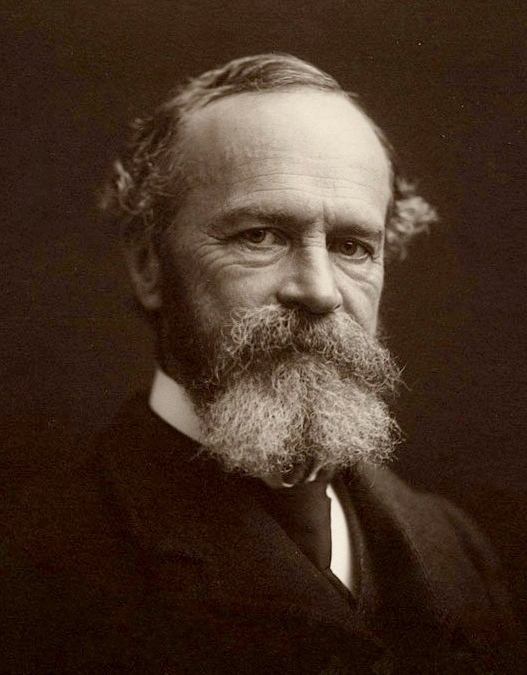
“Genius, in truth, means little more than the faculty of perceiving in an unhabitual way.”
Source: 1890s, The Principles of Psychology (1890), Ch. 19
Source: The Writings of William James
William James livre The Varieties of Religious Experience
Source: The Varieties of Religious Experience
William James The Will to Believe and Other Essays in Popular Philosophy
Source: The Will to Believe and Other Essays in Popular Philosophy
Source: 1890s, The Principles of Psychology (1890), Ch. 4
Source: Habit
Contexte: Keep the faculty of effort alive in you by a little gratuitous exercise every day. That is, be systematically ascetic or heroic in little unnecessary points, do every day or two something for no other reason than that you would rather not do it, so that when the hour of dire need draws nigh, it may find you not unnerved and untrained to stand the test. So with the man who has daily inured himself to habits of concentrated attention, energetic volition, and self-denial in unnecessary things. He will stand like a tower when everything rocks around him, and when his softer fellow-mortals are winnowed like chaff in the blast.
William James livre The Varieties of Religious Experience
Lectures XIV and XV, "The Value of Saintliness"
Source: 1900s, The Varieties of Religious Experience (1902)
Contexte: I am well aware of how anarchic much of what I say may sound. Expressing myself thus abstractly and briefly, I may seem to despair of the very notion of truth. But I beseech you to reserve your judgment until we see it applied to the details which lie before us. I do indeed disbelieve that we or any other mortal men can attain on a given day to absolutely incorrigible and unimprovable truth about such matters of fact as those with which religions deal. But I reject this dogmatic ideal not out of a perverse delight in intellectual instability. I am no lover of disorder and doubt as such. Rather do I fear to lose truth by this pretension to possess it already wholly.
Lecture VI, Pragmatism's Conception of Truth
1900s, Pragmatism: A New Name for Some Old Ways of Thinking (1907)
William James livre The Varieties of Religious Experience
Source: The Varieties of Religious Experience
“This life is worth living, we can say, since it is what we make it, from the moral point of view.”
William James Is Life Worth Living?
"Is Life Worth Living?"
1890s, The Will to Believe and Other Essays in Popular Philosophy (1897)
William James Is Life Worth Living?
"Is Life Worth Living?"
1890s, The Will to Believe and Other Essays in Popular Philosophy (1897)
Source: 1920s, Collected Essays and Reviews (1920), Ch. 11 - Clifford's Lectures and Essays" (1879)
William James Is Life Worth Living?
"Is Life Worth Living?"
1890s, The Will to Believe and Other Essays in Popular Philosophy (1897)
“As a rule we disbelieve all the facts and theories for which we have no use.”
"The Will to Believe" p. 10 http://books.google.com/books?id=Moqh7ktHaJEC&pg=PA10 <br class="br">1890s, The Will to Believe and Other Essays in Popular Philosophy (1897)
“Instinct leads, intelligence does but follow.”
Statement of 1902 quoted in The William James Reader (2007), Vol I, p. 264
1900s
Source: 1890s, The Principles of Psychology (1890), Ch. 10
Lecture II, What Pragmatism Means
1900s, Pragmatism: A New Name for Some Old Ways of Thinking (1907)


