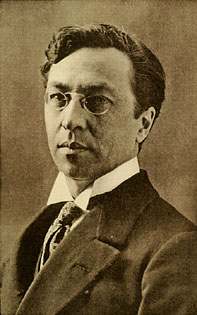
Vassily Kandinsky citations
Page 3

Vassily Kandinsky , né à Moscou le 22 novembre 1866 et mort à Neuilly-sur-Seine, le 13 décembre 1944, est un peintre, graveur, théoricien de l’art, poète et dramaturge russe, naturalisé allemand puis français.

Considéré comme l’un des artistes les plus importants du XXe siècle aux côtés, notamment, de Picasso et de Matisse, il est l'un des fondateurs de l'art abstrait : il est généralement considéré comme étant l’auteur de la première œuvre non figurative de l’histoire de l’art moderne, une aquarelle de 1910 qui sera dite « abstrait, ». Certains historiens ou critiques d'art ont soupçonné Kandinsky d'avoir antidaté cette aquarelle pour s'assurer la paternité de l'abstraction, au motif qu'elle ressemble à une esquisse de sa Composition VII, de 1913.

Cette aquarelle, qui serait le premier tableau abstrait au monde, a soulevé controverses et discussions, et suscité bien des thèses contradictoires. Deux tendances s'opposent : celle qui la date réellement de 1910, et qui l'inclut dans une série d'études pour Composition VII, celle qui rejette cette datation et la rapproche des œuvres et du style de 1913. Plaident pour cette dernière thèse le format inhabituel et trop grand pour l'époque, et surtout une inscription tardive de cette œuvre dans le registre manuscrit que tient régulièrement Kandinsky à partir de 1919. Wikipedia  

✵ 4. décembre 1866 – 13. décembre 1944  •  Autres noms Василий Кандинский
Vassily Kandinsky photo
Vassily Kandinsky: 80 citations0 J'aime

Vassily Kandinsky citations célèbres

Vassily Kandinsky Citations

Vassily Kandinsky: Citations en anglais

“I am working again on my painting 'Moscow' ['Moscow I' ('Mockba I'), 1916]. It is slowly taking shape in my imagination. And what was in the realm of wishing is now assuming real forms. What I have been lacking with this idea was depth and richness of sound, very earnest, complex, and easy at the same time.”

Wassily Kandinsky

Quote in his letter to Gabriele Münter, September 4, 1916; as cited in Hans K. Rothel and Jean K. Benjamin, Kandinsky: Catalogue Raisonné of the Oil Paintings, Volume Two, 1916–1944; Cornell University Press, Ithaca, N.Y, 1984, p. 580
1916 -1920

“Kandinsky, Wassily – painter, printmaker and author – the first painter to base painting on purely pictorial means of expression and abandon objects in his pictures.”

Wassily Kandinsky

Quote of Wassily Kandinsky, 1919 - his self-characterisation in &#x27;Das Kunstblatt&#x27;, 1919; as cited in &#x27;Klee &amp; Kandinsky&#x27;, 2015 exhibition text, Lenbachhaus und Kunstbau Munich, 2015-2016 https://www.zpk.org/en/exhibitions/review_0/2015/klee-kandinsky-969.html <br class="br">1916 -1920

“Of the 16 years that I have been living in Germany, I have given myself entirely to the German art world. How am I now suddenly supposed to feel myself a foreigner?”

Wassily Kandinsky

Quote in his letter to Herwarth Walden [of 'der Sturm'], August 2, 1914; as cited by lrike Becks-Malorny, in Wassily Kandinsky, 1866–1944: The Journey to Abstraction [Cologne: Taschen, 1999], p. 115
because of the outbreak of World War 1. Kandinsky had to leave Germany because of his Russian nationality
1910 - 1915

“It is never literally true that any form is meaningless and "says nothing." Every form in the world says something. But its message often fails to reach us, and even if it does, full understanding is often withheld from us. ] and, properly speaking, FORM IS THE OUTWARD EXPRESSION OF THIS INNER MEANING.”

Wassily Kandinsky

Part II. About painting : VI. The language of Form and Colour : Footnote
Similar quote in another translation:
There is no form, there is nothing in the world which says nothing. Often - it is true - the message does not reach our soul, either because it has no meaning in and for itself, or - as is more likely – because it has not been conveyed to the right place.. .Every serious work rings inwardly, like the calm and dignified words: 'Here I am!'
Partly cited in: Raymond Firth (2011) Symbols: Public and Private, p. 43
1910 - 1915, Concerning the Spiritual in Art, 1911

“Frankly, I think there is something wrong with Jawlensky's dots [in his paintings, then]. Anybody can pick up that style if they want to.”

Wassily Kandinsky

Quote of Kandinsky, c 1903; as cited by de:Wolf-Dieter Dube, in Expressionism; Praeger Publishers, New York, 1973, p. 114
1910 - 1915

“The geometric point is an invisible thing. Therefore, it must be defined as an incorporeal thing. Considered in terms of substance, it equals zero... Thus we look upon the geometric point as the ultimate and most singular union of silence and speech.”

Wassily Kandinsky

The geometric point has, therefore, been given its material form, in the first instance, in writing. It belongs to language and signifies silence.
1920 - 1930, Point and line to plane, 1926

Auteurs similaires

Alexandre Soljenitsyne photo
Alexandre Soljenitsyne20
écrivain russe None
Khalil Gibran photo
Khalil Gibran13
poète et peintre libanais None
Vladimir Poutine photo
Vladimir Poutine13
personnalité politique russe None
Vladimir Nabokov photo
Vladimir Nabokov39
écrivain None
Salvador Dalí photo
Salvador Dalí44
peintre, sculpteur, graveur, scénariste et écrivain catalan None
 Romain Gary photo
Romain Gary130
écrivain et diplomate français None
Jean Cocteau photo
Jean Cocteau31
écrivain, peintre et réalisateur français None
Guillaume Apollinaire photo
Guillaume Apollinaire33
poète français None
Joseph Staline photo
Joseph Staline4
Secrétaire général du Comité central du Parti communiste de… None
Winston Churchill photo
Winston Churchill23
homme d'État britannique None