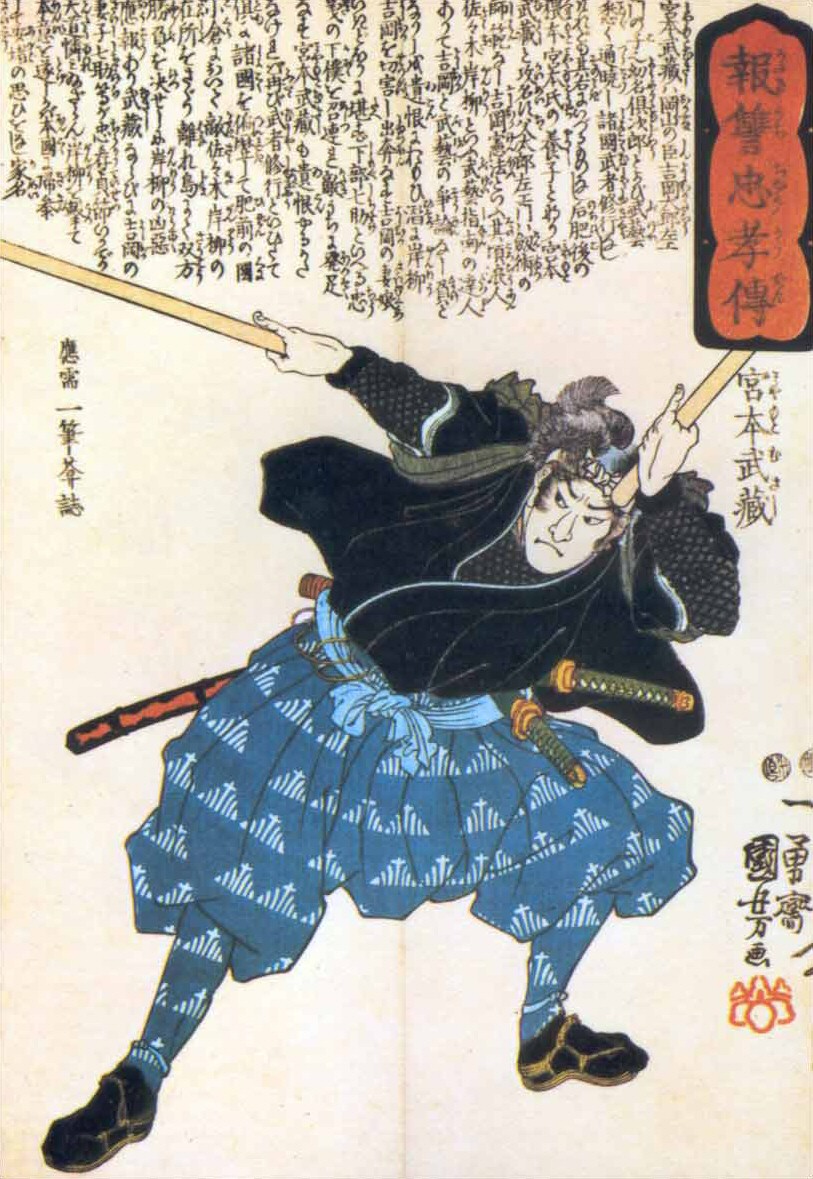
Miyamoto Musashi: Citations en anglais
Go Rin No Sho (1645), The Water Book
Go Rin No Sho (1645), The Ground Book
Go Rin No Sho (1645), The Fire Book
Go Rin No Sho (1645), The Fire Book
“The Ni To Ichi Way of strategy is recorded in this the Book of the Void.”
Go Rin No Sho (1645), The Book No-Thing-ness
Go Rin No Sho (1645), The Fire Book
Go Rin No Sho (1645), The Ground Book
Go Rin No Sho (1645), The Fire Book
Go Rin No Sho (1645), The Water Book
Variant translation: First, as is often said, a samurai must have both literary and martial skills: to be versed in the two is his duty. Even if he has no natural ability, a samurai must train assiduously in both skills to a degree appropriate to his status. On the whole, if you are to assess the samurai's mind, you may think it is simply attentiveness to the manner of dying.
Go Rin No Sho (1645), The Ground Book
Go Rin No Sho (1645), The Fire Book
Go Rin No Sho (1645), The Fire Book
Go Rin No Sho (1645), The Ground Book
Go Rin No Sho (1645), The Water Book
“Step by step walk the thousand-mile road.”
Go Rin No Sho (1645), The Water Book
Go Rin No Sho (1645), The Fire Book
Go Rin No Sho (1645), The Fire Book
Go Rin No Sho (1645), The Wind Book
Contexte: It is difficult for these people to cut the enemy when at close quarters because of the length of the long sword. The blade path is large so the long sword is an encumbrance, and they are at a disadvantage compared to the man armed with a short companion sword.
From olden times it has been said: "Great and small go together." So do not unconditionally dislike extra-long swords. What I dislike is the inclination towards the long sword. If we consider large-scale strategy, we can think of large forces in terms of long swords, and small forces as short swords. Cannot few men give battle against many? There are many instances of few men overcoming many.
Go Rin No Sho (1645), The Wind Book
“Fixed formation is bad. Study this well.”
Go Rin No Sho (1645), The Water Book
Go Rin No Sho (1645), The Water Book


