“Vos succès ne sont pas rendus publics; vos échecs sont annoncés à la trompette.”
Your successes are unheralded, your failures are trumpeted.
en
Discours au QG de la CIA le 28 novembre 1961
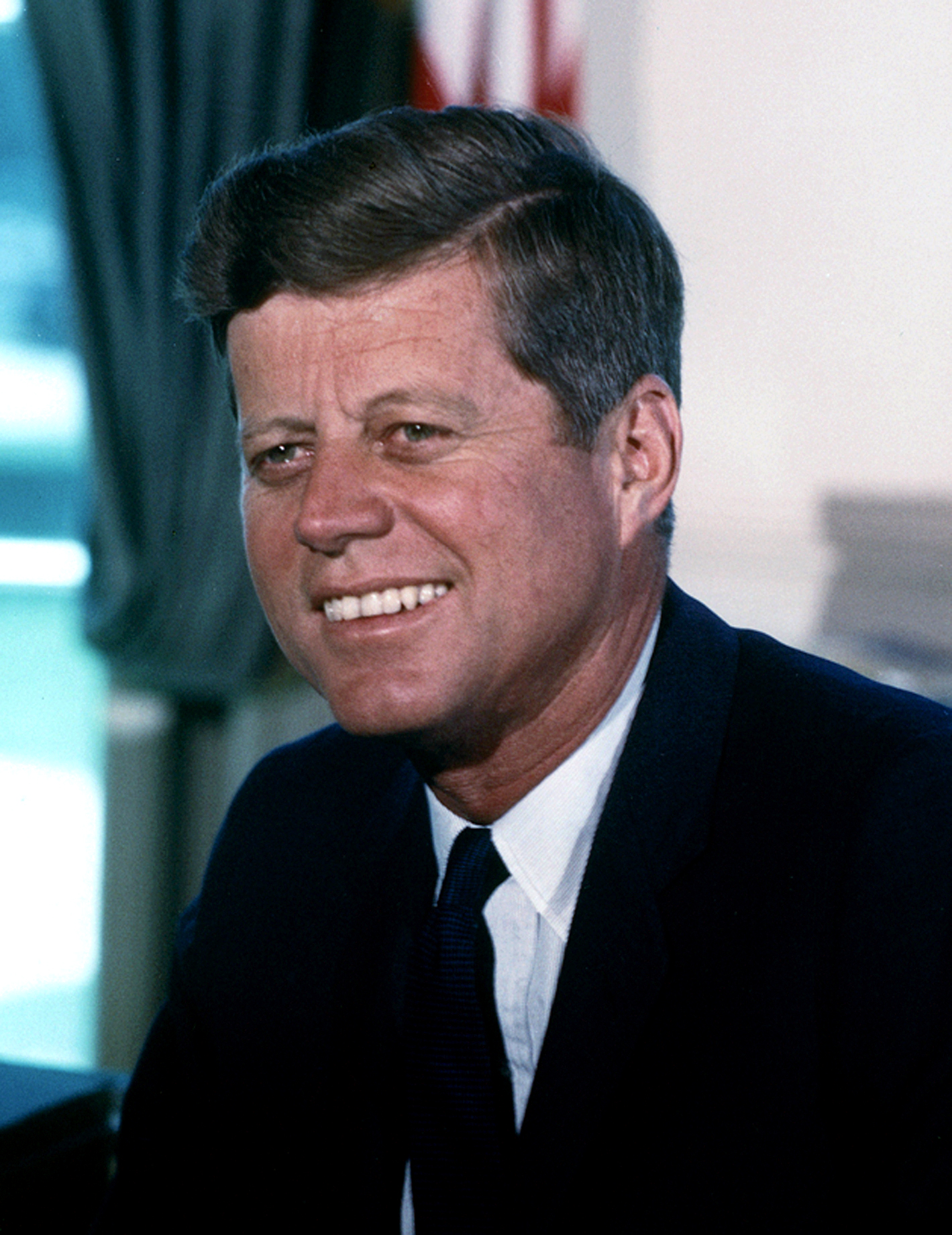
John Fitzgerald Kennedy dit Jack Kennedy, souvent désigné par ses initiales JFK, né le 29 mai 1917 à Brookline est un homme d'État américain, 35e président des États-Unis. Il est assassiné le 22 novembre 1963 à Dallas, moins de trois ans après son entrée à la Maison-Blanche. Entré en fonction le 20 janvier 1961, il est à 43 ans la plus jeune personne élue à ce poste.
Il laisse son empreinte dans l'histoire des États-Unis par sa gestion de la crise des missiles de Cuba, son autorisation du débarquement de la baie des Cochons, son engagement pour le traité d'interdiction partielle des essais nucléaires, son programme spatial dans le cadre de la course à l'espace, son opposition à la construction du mur de Berlin et sa politique d'égalité des genres. Ses prises de position en faveur de l'Accord général sur les tarifs douaniers et le commerce lui valurent d'être respecté jusque chez les républicains, et le mouvement afro-américain des droits civiques — qu'il soutenait, voulant mieux intégrer les minorités dans la société — qui prit place durant sa présidence annonçait la déségrégation ; dans un même temps, il fut admiré par les dirigeants étrangers pour l'aide qu'il fournit aux pays en développement au travers de l'Alliance pour le Progrès et des Corps de la Paix. Son programme, basé sur le slogan « Nouvelle Frontière », de stimulation de l'économie, de lutte contre la pauvreté et de magnification de l'Amérique par l'innovation, fut également réutilisé par les démocrates après sa mort en son honneur.
“Vos succès ne sont pas rendus publics; vos échecs sont annoncés à la trompette.”
Your successes are unheralded, your failures are trumpeted.
en
Discours au QG de la CIA le 28 novembre 1961
“Ceux qui rendent une révolution pacifique impossible rendront une révolution violente inévitable.”
Those who make peaceful revolution impossible will make violent revolution inevitable.
en
Source: John F. Kennedy 1917-63: Chronology-documents-bibliographical aids
“Children are the world's most valuable resource and its best hope for the future.”
Re: United States Committee for UNICEF (25 July 1963); Box 11, President's Outgoing Executive Correspondence Series, White House Central Chronological File, Presidential Papers, Papers of John F. Kennedy http://www.jfklibrary.org/Research/Research-Aids/Ready-Reference/JFK-Quotations.aspx <br class="br">1963
1963, Speech at Amherst College
Contexte: If art is to nourish the roots of our culture, society must set the artist free to follow his vision wherever it takes him. We must never forget that art is not a form of propaganda; it is a form of truth.
Contexte: If art is to nourish the roots of our culture, society must set the artist free to follow his vision wherever it takes him. We must never forget that art is not a form of propaganda; it is a form of truth. And as Mr. MacLeish once remarked of poets, there is nothing worse for our trade than to be in style. In free society art is not a weapon and it does not belong to the spheres of polemic and ideology. Artists are not engineers of the soul. It may be different elsewhere. But democratic society — in it, the highest duty of the writer, the composer, the artist is to remain true to himself and to let the chips fall where they may. In serving his vision of the truth, the artist best serves his nation. And the nation which disdains the mission of art invites the fate of Robert Frost's hired man, the fate of having "nothing to look backward to with pride, and nothing to look forward to with hope."
John F. Kennedy: "Remarks on the 20th Anniversary of the Voice of America" (26 February 1962) http://www.presidency.ucsb.edu/ws/index.php?pid=9075&st=&st1=<!-- Online by Gerhard Peters and John T. Woolley, The American Presidency Project --> <br class="br">1962 <br class="br">Contexte: We welcome the views of others. We seek a free flow of information across national boundaries and oceans, across iron curtains and stone walls. We are not afraid to entrust the American people with unpleasant facts, foreign ideas, alien philosophies, and competitive values. For a nation that is afraid to let its people judge the truth and falsehood in an open market is a nation that is afraid of its people.
John F. Kennedy livre Profiles in Courage
1963, American University speech
Variante: For in the final analysis, our most basic common link, is that we all inhabit this small planet, we all breathe the same air, we all cherish our children's futures, and we are all mortal.
Source: Profiles in Courage
Contexte: In short, both the United States and its allies, and the Soviet Union and its allies, have a mutually deep interest in a just and genuine peace and in halting the arms race. Agreements to this end are in the interests of the Soviet Union as well as ours — and even the most hostile nations can be relied upon to accept and keep those treaty obligations, and only those treaty obligations, which are in their own interest. So, let us not be blind to our differences — but let us also direct attention to our common interests and to the means by which those differences can be resolved. And if we cannot end now our differences, at least we can help make the world safe for diversity. For, in the final analysis, our most basic common link is that we all inhabit this small planet. We all breathe the same air. We all cherish our children's future. And we are all mortal.
Remarks at Amherst College (26 October 1963) http://millercenter.org/president/speeches/speech-3379 <br class="br">1963, Speech at Amherst College
1963, Address in the Assembly Hall at the Paulskirche in Frankfurt
Variante: Change is the law of life. And those who look only to the past or the present are certain to miss the future.
Documents on International Affairs, 1963, Royal Institute of International Affairs, ed. Sir John Wheeler Wheeler-Bennett, p. 36.
1962, Address at Independence Hall
Pierre Salinger, With Kennedy (1966), Chapter 1: Lancer to Wayside, page 1 http://books.google.de/books?id=vx45mXCc4JoC&pg=PA1&lpg=PA1&dq=If+anyone+is+crazy+enough+to+want+to+kill+a+president+of+the+United+States,+he+can+do+it.+All+he+must+be+prepared+to+do+is+give+his+life+for+the+president%E2%80%99s.&source=bl&ots=Bom2TtsfyN&sig=WyeTm82PlS5xBDf7-sIY6xehqbo&hl=de&sa=X&ei=OewXUqv8JJSihgf07IHICA&ved=0CDAQ6AEwADgU#v=onepage&q=If%20anyone%20is%20crazy%20enough%20to%20want%20to%20kill%20a%20president%20of%20the%20United%20States%2C%20he%20can%20do%20it.%20All%20he%20must%20be%20prepared%20to%20do%20is%20give%20his%20life%20for%20the%20president%E2%80%99s.&f=false <br class="br">Attributed
1962, Second Letter to Nikita Khrushchev
"Special message to Congress: Program for Economic Recovery and Growth (17)", (2 February 1961) http://www.jfklibrary.org/Research/Research-Aids/Ready-Reference/JFK-Quotations.aspx <br class="br">1961
1963, Address in the Assembly Hall at the Paulskirche in Frankfurt
1963, Address in the Assembly Hall at the Paulskirche in Frankfurt
Remarks at the Unidad Independencia Housing Project, City of Mexico (269)" (30 June 1962) http://www.jfklibrary.org/Research/Research-Aids/Ready-Reference/JFK-Quotations.aspx <br class="br">1962
1960, Sport at the New Frontier: The Soft American
Quoted in A Thousand Days: John F. Kennedy in the White House, Arthur Schlesinger (Boston: Houghton Mifflin Company, 1965), page 1017. http://www.jfklibrary.org/Research/Research-Aids/Ready-Reference/JFK-Quotations.aspx According to a footnote in Schlesinger's manuscript (1st draft, page 1378), this was stated on February 13, 1961. <br class="br">Attributed
1962, Second Letter to Nikita Khrushchev
Radio and television report to the American people on civil rights (11 June 1963)]
1963, Civil Rights Address
1963, Speech at Amherst College
Contexte: The men who create power make an indispensable contribution to the Nation's greatness, but the men who question power make a contribution just as indispensable, especially when that questioning is disinterested, for they determine whether we use power or power uses us.
Source: 1962, Cuban Missile Crisis speech


