“Vos succès ne sont pas rendus publics; vos échecs sont annoncés à la trompette.”
Your successes are unheralded, your failures are trumpeted.
en
Discours au QG de la CIA le 28 novembre 1961
John Fitzgerald Kennedy dit Jack Kennedy, souvent désigné par ses initiales JFK, né le 29 mai 1917 à Brookline est un homme d'État américain, 35e président des États-Unis. Il est assassiné le 22 novembre 1963 à Dallas, moins de trois ans après son entrée à la Maison-Blanche. Entré en fonction le 20 janvier 1961, il est à 43 ans la plus jeune personne élue à ce poste.
Il laisse son empreinte dans l'histoire des États-Unis par sa gestion de la crise des missiles de Cuba, son autorisation du débarquement de la baie des Cochons, son engagement pour le traité d'interdiction partielle des essais nucléaires, son programme spatial dans le cadre de la course à l'espace, son opposition à la construction du mur de Berlin et sa politique d'égalité des genres. Ses prises de position en faveur de l'Accord général sur les tarifs douaniers et le commerce lui valurent d'être respecté jusque chez les républicains, et le mouvement afro-américain des droits civiques — qu'il soutenait, voulant mieux intégrer les minorités dans la société — qui prit place durant sa présidence annonçait la déségrégation ; dans un même temps, il fut admiré par les dirigeants étrangers pour l'aide qu'il fournit aux pays en développement au travers de l'Alliance pour le Progrès et des Corps de la Paix. Son programme, basé sur le slogan « Nouvelle Frontière », de stimulation de l'économie, de lutte contre la pauvreté et de magnification de l'Amérique par l'innovation, fut également réutilisé par les démocrates après sa mort en son honneur.
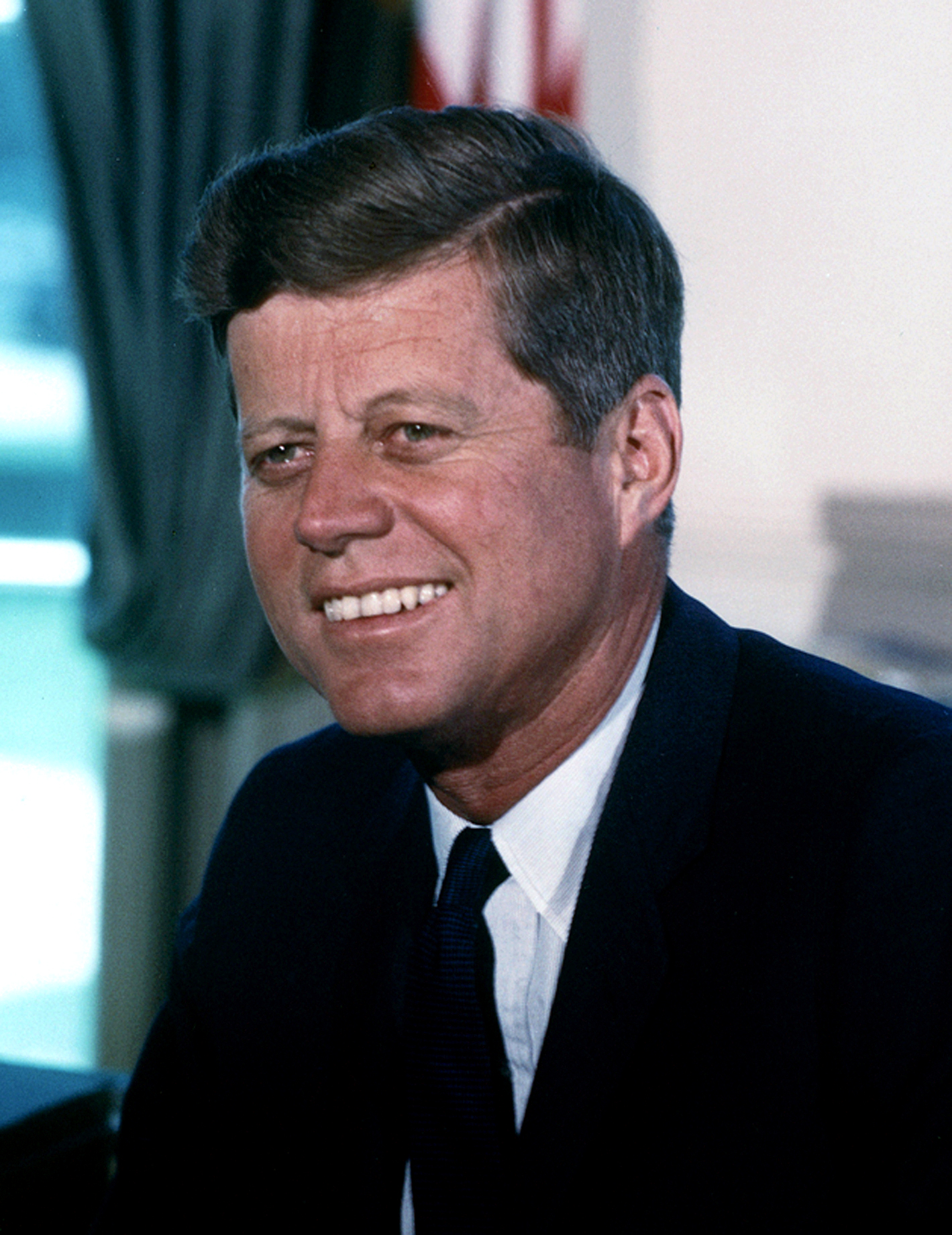
“Vos succès ne sont pas rendus publics; vos échecs sont annoncés à la trompette.”
Your successes are unheralded, your failures are trumpeted.
en
Discours au QG de la CIA le 28 novembre 1961
“Ceux qui rendent une révolution pacifique impossible rendront une révolution violente inévitable.”
Those who make peaceful revolution impossible will make violent revolution inevitable.
en
Slightly misquoting Domingo Ortega, as translated by the English poet Robert Graves), in remarks during a Presidential Backgrounder before the National Foreign Policy Conference for Editors and Radio-TV Public Affairs Broadcasters (16 October 1962)]; "Presidential Backgrounder 16 October 1962 #50," Box 134, Classified Background Briefing Material Series, Pierre Salinger Papers, John F. Kennedy Presidential Library
The original poem: Bullfight critics ranked in rows
Crowd the enormous Plaza full
But only one is there who knows
And he's the man who fights the bull.
1962
Message to Chairman Khrushchev Concerning the Meaning of Events in Cuba (18 April 1961) http://www.presidency.ucsb.edu/ws/?pid=8070 <br class="br">1961
Related in The Pleasure of His Company, Paul Fay, Jr., New York: Harper & Row, 1966, p. 190. http://www.jfklibrary.org/Research/Research-Aids/Ready-Reference/JFK-Quotations.aspx <br class="br">Attributed
1962, Address at Independence Hall
1963, Speech at Amherst College
1963, Address at Vanderbilt University
1962, Address and Question and Answer Period at the Economic Club of New York (549)
1962, Address and Question and Answer Period at the Economic Club of New York (549)
Source: 1962, Address and Question and Answer Period at the Economic Club of New York (549)
Source: 1962, Address at Independence Hall
1961, Berlin Crisis speech
1962, Address and Question and Answer Period at the Economic Club of New York (549)
May 1961 in address to joint session of congress https://www.jfklibrary.org/learn/about-jfk/historic-speeches/address-to-joint-session-of-congress-may-25-196125 <br class="br">1961
“Message to Those Participating in Roosevelt Day Commemoration (29 January 1961) http://www.jfklibrary.org/learn/about-jfk/life-of-john-f-kennedy/john-f-kennedy-quotations/commemorative-message-on-roosevelt-day." Papers of John F. Kennedy. Presidential Papers, "New Minute Men Urged by Kennedy," The New York Times(30 January 1961) pg. 13 <br class="br">1961
1963, Speech at Amherst College
“Freedom is indivisible, and when one man is enslaved, all are not free.”
John F. Kennedy livre Ich bin ein Berliner
Source: "Ich bin ein Berliner" Speech, June 26, 1963, https://en.wikipedia.org/wiki/File:Ich_bin_ein_Berliner_Speech_(June_26,_1963)_John_Fitzgerald_Kennedy_trimmed.theora.ogv
Contexte: Freedom is indivisible, and when one man is enslaved, all are not free. When all are free, then we can look forward to that day when this city will be joined as one and this country and this great Continent of Europe in a peaceful and hopeful globe. When that day finally comes, as it will, the people of West Berlin can take sober satisfaction in the fact that they were in the front lines for almost two decades.
Source: 1962, Address and Question and Answer Period at the Economic Club of New York
Source: 1962, Address and Question and Answer Period at the Economic Club of New York
“When I was a Congressman I never realized how important Congress was, but now I do.”
Source: 1962, Address and Question and Answer Period at the Economic Club of New York
Source: 1962, Address and Question and Answer Period at the Economic Club of New York
Source: 1962, Address and Question and Answer Period at the Economic Club of New York
Source: 1962, Address and Question and Answer Period at the Economic Club of New York
Source: 1962, Address and Question and Answer Period at the Economic Club of New York
Source: 1962, Address and Question and Answer Period at the Economic Club of New York
Source: 1962, Address and Question and Answer Period at the Economic Club of New York
Source: 1962, Address and Question and Answer Period at the Economic Club of New York


