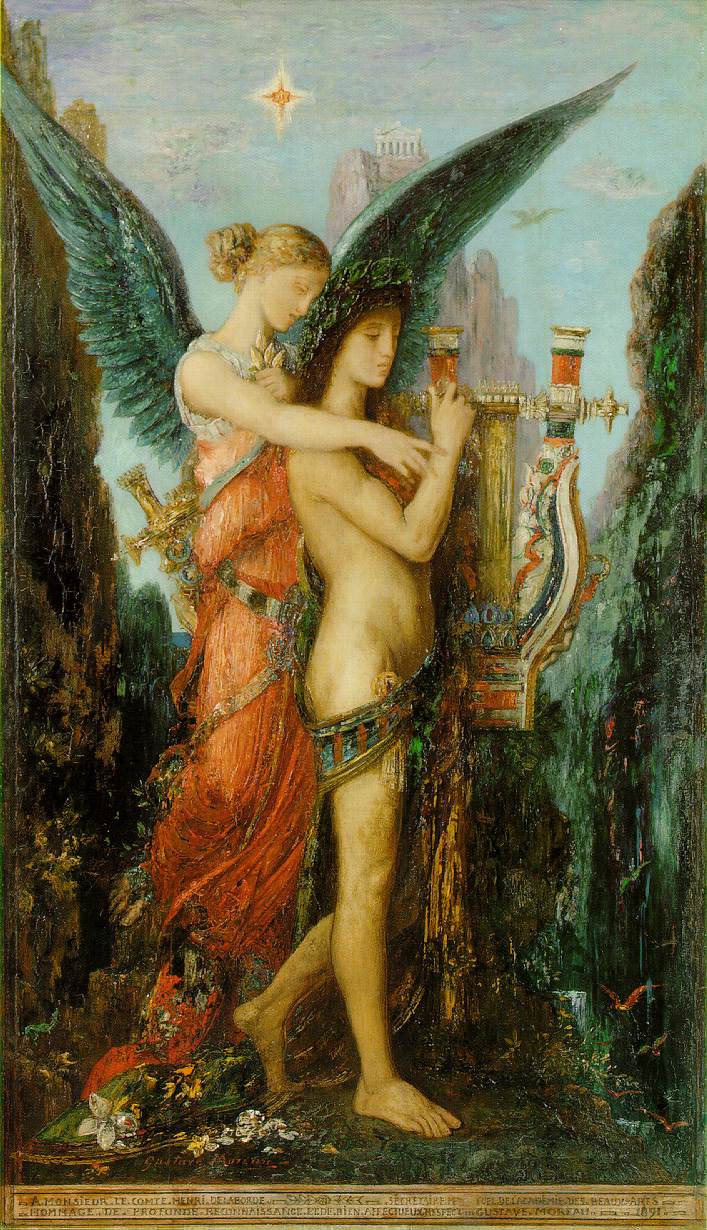
Μουσάων Ἑλικωνιάδων ἀρχώμεθ’ ἀείδειν,
La Théogonie
Hésiode: 69 citations0 J'aime
Hésiode citations célèbres
ἤτοι μὲν πρώτιστα Χάος γένετ’· αὐτὰρ ἔπειτα
La Théogonie
“Qui se fie à une femme se fie aux voleurs.”
Hésiode livre Les Travaux et les Jours
ὃς δὲ γυναικὶ πέποιθε, πέποιθ’ ὅ γε φιλήτῃσιν.
grc
Les Travaux et les Jours
“Ne remettez rien au lendemain ni au surlendemain.”
Hésiode livre Les Travaux et les Jours
μηδ’ ἀναβάλλεσθαι ἔς τ’ αὔριον ἔς τε ἔνηφι.
grc
Les Travaux et les Jours
“Gain mal acquis vaut un désastre.”
Hésiode livre Les Travaux et les Jours
κακὰ κέρδεα ἶσ’ ἄτῃσι.
grc
Les Travaux et les Jours
ἴδμεν ψεύδεα πολλὰ λέγειν ἐτύμοισιν ὁμοῖα,
La Théogonie
“Le potier en veut au potier, l'aède à l'aède et le mendiant au mendiant.”
Citations raportées, Lysis
Hésiode livre Les Travaux et les Jours
τὴν μέν τοι κακότητα καὶ ἰλαδὸν ἔστιν ἑλέσθαι
Les Travaux et les Jours
Hésiode: Citations en anglais
“From whose eyelids also as they gazed dropped love.”
Source: The Theogony (c. 700 BC), line 910.
Hesiod livre Les Travaux et les Jours
Source: Works and Days (c. 700 BC), line 304.
Hesiod livre Les Travaux et les Jours
Source: Works and Days (c. 700 BC), line 410.
“Observe due measure, for right timing is in all things the most important factor.”
Hesiod livre Les Travaux et les Jours
Source: Works and Days (c. 700 BC), line 694.
“It is not possible to deceive or go beyond the will of Zeus.”
Source: The Theogony (c. 700 BC), line 613.
“He harms himself who does harm to another, and the evil plan is most harmful to the planner.”
Hesiod livre Les Travaux et les Jours
οἷ γ᾽ αὐτῷ κακὰ τεύχει ἀνὴρ ἄλλῳ κακὰ τεύχων<br>ἡ δὲ κακὴ βουλὴ τῷ βουλεύσαντι κακίστη. <br class="br">The man who does evil to another does evil to himself, and the evil counsel is most evil for him who counsels it. <br class="br">He for himself weaves woe who weaves for others woe,<br>and evil counsel recoils on the counsellor. https://archive.org/stream/b24865898#page/432/mode/2up <br class="br">Source: Works and Days (c. 700 BC), lines 265-266
Hesiod livre Les Travaux et les Jours
Source: Works and Days (c. 700 BC), line 11.
“Sometimes a day is a step mother, sometimes a mother.”
Hesiod livre Les Travaux et les Jours
Source: Works and Days (c. 700 BC), line 825.
“Work is no disgrace: it is idleness which is a disgrace.”
Hesiod livre Les Travaux et les Jours
Source: Works and Days (c. 700 BC), line 311.
“The dawn speeds a man on his journey, and speeds him too in his work.”
Hesiod livre Les Travaux et les Jours
Source: Works and Days (c. 700 BC), line 579.
Hesiod livre Les Travaux et les Jours
Source: Works and Days (c. 700 BC), line 260.
Hesiod livre Les Travaux et les Jours
Source: Works and Days (c. 700 BC), line 761.
Hesiod livre Les Travaux et les Jours
Source: Works and Days (c. 700 BC), line 695.
“Invite the man that loves thee to a feast, but let alone thine enemy.”
Hesiod livre Les Travaux et les Jours
Source: Works and Days (c. 700 BC), line 342.
Hesiod livre Les Travaux et les Jours
Source: Works and Days (c. 700 BC), line 271.
“Wealth should not be seized: god-given wealth is much better.”
Hesiod livre Les Travaux et les Jours
Source: Works and Days (c. 700 BC), line 320.
This quote has been attributed to Hesiod on the internet, and even published with citation as a dubious attribution, but there are no known occurrences of it in his writings.
Misattributed
Hesiod livre Les Travaux et les Jours
Source: Works and Days (c. 700 BC), line 225.
“For a man wins nothing better than a good wife, and, again, nothing worse than a bad one.”
Hesiod livre Les Travaux et les Jours
Source: Works and Days (c. 700 BC), line 702.
Hesiod livre Les Travaux et les Jours
Source: Works and Days (c. 700 BC), line 369.
Source: The Theogony (c. 700 BC), line 603.
“For trust and mistrust, alike ruin men.”
Hesiod livre Les Travaux et les Jours
Source: Works and Days (c. 700 BC), line 372.
“The gods have placed sweat as the price of all things.”
Perhaps a mistranslation of line 289 of Works and Days, actually:
: But in front of excellence the immortal gods have put sweat
Misattributed
“Fools, they do not even know how much more is the half than the whole.”
Hesiod livre Les Travaux et les Jours
Source: Works and Days (c. 700 BC), line 40; often translated as "The half is greater than the whole."
Hesiod livre Les Travaux et les Jours
Source: Works and Days (c. 700 BC), line 643.
“Diligence increaseth the fruit of toil. A dilatory man wrestles with losses.”
Hesiod livre Les Travaux et les Jours
Source: Works and Days (c. 700 BC), line 412.
“Do not seek evil gains; evil gains are the equivalent of disaster.”
Hesiod livre Les Travaux et les Jours
Gain not base gains; base gains are the same as losses.
Source: Works and Days (c. 700 BC), line 352; compare: "the gains of the wicked bring trouble", Book of Proverbs 15:6.
We know to tell many fictions like to truths, and we know, when we will, to speak what is true.
We know how to tell many lies that pass for truth, and we know, when we wish, to tell the truth itself.
Source: The Theogony (c. 700 BC), lines 27–28. Variant translations:
“On the tongue of such an one they shed a honeyed dew, and from his lips drop gentle words.”
Source: The Theogony (c. 700 BC), line 82.


