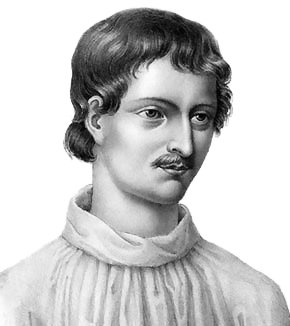
Giordano Bruno Citations
Giordano Bruno: Citations en anglais
“He who wants Lent to seem short, should contract a debt to be repaid at Easter.”
Giordano Bruno livre Candelaio
Candelaio, Act IV, Scene XVII. — (Lucia.)
Translation reported in Harbottle’s Dictionary of quotations French and Italian (1904), p. 275
“Time is the father of truth, its mother is our mind.”
Quote as translated in The Encyclopedia of Religion Vol. 11 (1987), by Mircea Eliade, p. 459
The Ash Wednesday Supper (1584)
Cause, Principle, and Unity (1584)
Variante: Everything that makes diversity of kinds, of species. differences, properties, everything that consists in generation, decay, alteration and change, is not an entity, but condition and circumstances of entity and being, which is one, infinite, immobile, subject, matter, life, soul, truth and good.
Introductory Epistle
On the Infinite Universe and Worlds (1584)
As translated by Arthur Imerti (1964)
The Expulsion of the Triumphant Beast (1584)
On the Monad, Number, and Figure (1591)
As translated by Arthur Imerti (1964)
The Expulsion of the Triumphant Beast (1584)
IV 9; as translated by Dorothea Waley Singer (1950)
De immenso (1591)
“If it is not true it is very well invented.”
[bentrovato] Se non è vero, è molto ben trovato.
De gli heroici furori (1585) [The Heroic Furies; also translated as On Heroic Frenzies], as quoted in A Book of Quotations, Proverbs and Household Words (1907) edited by Sir William Gurney Benham
Variant translations:
If it is not true, it is well conceived.
If it is not true, it is a good story.
VIII 2, as quoted in The Acentric Labyrinth (1995) by Ramon Mendoza
De immenso (1591)
Dedication
On the Infinite Universe and Worlds (1584)
Cause, Principle, and Unity (1584)
Contexte: It is manifest... that every soul and spirit hath a certain continuity with the spirit of the universe, so that it must be understood to exist and to be included not only there where it liveth and feeleth, but it is also by its essence and substance diffused throughout immensity... The power of each soul is itself somehow present afar in the universe... Naught is mixed, yet is there some presence.
Anything we take in the universe, because it has in itself that which is All in All, includes in its own way the entire soul of the world, which is entirely in any part of it.
VIII 10 as translated by Dorothea Waley Singer (1950)
De immenso (1591)
As translated by Arthur Imerti (1964)
The Expulsion of the Triumphant Beast (1584)
As translated by Paul Harrison
Cause, Principle, and Unity (1584)
As quoted in "Giordano Bruno" by Thomas Davidson, in The Index Vol. VI. No. 36 (4 March 1886), p. 429
“I pray you, magnificent Sir, do not trouble yourself to return to us, but await our coming to you.”
Third Dialogue
On the Infinite Universe and Worlds (1584)
Declaration about the scholars of England, particularly those of Oxford
The Ash Wednesday Supper (1584)
As translated by Arthur Imerti (1964)
The Expulsion of the Triumphant Beast (1584)
V 9; as translated by Dorothea Waley Singer (1950)
De immenso (1591)
Cabal of the Cheval Pegasus (1585)
Cause, Principle, and Unity (1584)
Fifth Dialogue
The Ash Wednesday Supper (1584)
“Candelaio, Act IV, Scene XVII.”
(Lucia.)
Chi vuole che la quaresima gli paia corta, si faccia debito per pagare a Pasqua.
Translation: He who wants Lent to seem short, should contract a debt to be repaid at Easter.
Translation reported in Harbottle’s Dictionary of quotations French and Italian (1904), p. 275


