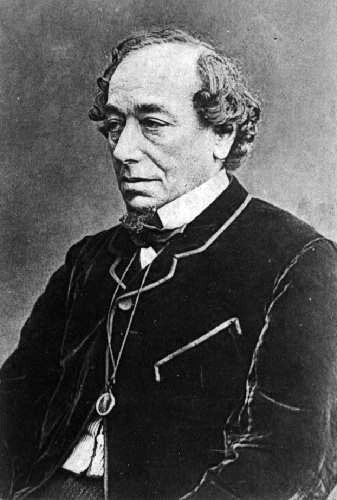
Benjamin Disraeli citations
Page 5

Benjamin Disraeli, né le 21 décembre 1804 et mort le 19 avril 1881 à Londres, est un homme d'État et écrivain britannique, Premier ministre du Royaume-Uni à deux reprises. Il joue un rôle central dans la création du Parti conservateur moderne dont il formalise la doctrine. Par sa grande influence sur la politique étrangère, il a associé les conservateurs à la gloire et à la puissance de l'Empire britannique.

Né dans une famille juive, Benjamin Disraeli est élevé dans la foi anglicane car son père est en conflit avec sa synagogue. Il entame une carrière d'avocat mais se tourne vers la politique dans les années 1830 et est élu à la Chambre des communes comme député de Maidstone en 1837. Lorsque les conservateurs prennent le pouvoir en 1841, Disraeli n’intègre pas le gouvernement du Premier ministre Robert Peel. Cinq ans plus tard, Peel divise le parti en demandant l'abrogation des Corn Laws qui limitaient les importations de céréales : il est violemment attaqué par Disraeli. Peu de notables conservateurs rompent avec Peel, et Disraeli devient alors une figure importante du parti même si beaucoup se méfient de lui. Il est trois fois chancelier de l'Échiquier et chef de la Chambre des communes au sein des cabinets de Lord Derby dans les années 1850 et 1860. Il développe à cette période une forte rivalité avec le libéral William Ewart Gladstone.

Lorsque Derby démissionne pour des raisons de santé en février 1868, Disraeli devient Premier ministre mais perd les élections à la fin de l'année. Il représente alors l'Opposition avant de mener son parti à la victoire en 1874. Il développe une forte amitié avec la reine Victoria qui le fait comte de Beaconsfield en 1876. Le second mandat de Disraeli est dominé par la question d'Orient, désignant le déclin de l'Empire ottoman et les actions des autres pays européens, notamment la Russie, pour en profiter. Il pousse ainsi les intérêts britanniques à prendre des parts dans la compagnie du canal de Suez en Égypte ottomane. En 1878, devant les victoires russes contre les Ottomans, Disraeli mène la délégation britannique au congrès de Berlin et négocie des termes favorables au Royaume-Uni.

Même si Disraeli est félicité pour ses actions à Berlin, d'autres événements affectent le soutien à son gouvernement : les guerres en Afghanistan et en Afrique du Sud sont critiquées, et il irrite les agriculteurs britanniques en refusant de rétablir les Corn Laws. Gladstone mène une campagne efficace et le parti libéral remporte les élections de 1880.

Auteur de plusieurs romans depuis 1826, Benjamin Disraeli publie sa dernière œuvre, Endymion, peu avant sa mort à l'âge de 76 ans. Wikipedia  

✵ 21. décembre 1804 – 19. avril 1881
Benjamin Disraeli photo
Benjamin Disraeli: 307 citations0 J'aime

Benjamin Disraeli Citations

Benjamin Disraeli: Citations en anglais

“Lord Salisbury and myself have brought you back peace, but a peace, I hope, with honour which may satisfy our Sovereign, and tend to the welfare of the country.”

Benjamin Disraeli

Source: From the window of 10 Downing Street, after arriving from Dover (16 July 1878), quoted in 'Return Of Lord Beaconsfield And Lord Salisbury', The Times (17 July 1878), p. 5.

“That fatal drollery called a representative government.”

Benjamin Disraeli

Bk. II, Ch. 13.
Books, Coningsby (1844), Tancred (1847)

“Real politics are the possession and distribution of power.”

Benjamin Disraeli

Source: Books, Coningsby (1844), Endymion (1880), Ch. 71 .

“We have brought a peace, and we trust we have brought a peace with honour, and I trust that that will now be followed by the prosperity of the country.”

Benjamin Disraeli

Source: Speech at Dover, England after arriving from the Congress of Berlin (16 July 1878), quoted in 'Return Of Lord Beaconsfield And Lord Salisbury', The Times (17 July 1878), p. 5.

“There is no gambling like politics.”

Benjamin Disraeli

Source: Books, Coningsby (1844), Endymion (1880), Ch. 82.

“Taking a new step, uttering a new word, is what people fear most.”

Benjamin Disraeli

This comes from Dostoevsky's Crime and Punishment, part 1, chapter 1.
Misattributed

“I am dead: dead, but in the Elysian fields.”

Benjamin Disraeli

Source: Remark to Lord Aberdare on being welcomed to the House of Lords (1876), cited by Stanley Weintraub, Disraeli: A Biography (1993), p. 563.

“No man is regular in his attendance at the House of Commons until he is married.”

Benjamin Disraeli

Theory held by Disraeli, cited in Sir William Fraser, Disraeli and his Day (1891), p. 142.
Sourced but undated

“Finality, Sir, is not the language of politics.”

Benjamin Disraeli

Speech http://hansard.millbanksystems.com/commons/1859/feb/28/leave in the House of Commons (28 February 1859). <br class="br">1850s

“The practice of politics in the East may be defined by one word: dissimulation.”

Benjamin Disraeli

Part 5, Chapter 10.
Books, Coningsby (1844), Contarini Fleming (1832)

“The characteristic of the present age is a craving credulity.”

Benjamin Disraeli

Source: Speech at Oxford Diocesan Conference (25 November 1864), quoted in William Flavelle Monypenny and George Earle Buckle, The Life of Benjamin Disraeli, Earl of Beaconsfield. Volume II. 1860&ndash;1881 (London: John Murray, 1929), p. 105.

“Individuals may form communities, but it is institutions alone that can create a nation.”

Benjamin Disraeli

Speech in the Guildhall, London (9 November 1866), quoted in The Times (10 November 1866), p. 9
1860s

“I have always thought that every woman should marry, and no man.”

Benjamin Disraeli

Source: Books, Coningsby (1844), Lothair (1870), Ch. 30.

“The choicest pleasures of life lie within the ring of moderation.”

Benjamin Disraeli

Actually a line from Martin Tupper's Proverbial Philosophy.
Misattributed

“Sir, very few people reach posterity. Who amongst us may arrive at that destination I presume not to vaticinate. Posterity is a most limited assembly. Those gentlemen who reach posterity are not much more numerous than the planets.”

Benjamin Disraeli

Speech http://hansard.millbanksystems.com/commons/1846/jan/22/address-in-answer-to-the-speech in the House of Commons (22 January 1846). <br class="br">1840s

“We are the children of the gods, and are never more the slaves of circumstance than when we deem ourselves their masters. What may next happen in the dazzling farce of life, the Fates only know.”

Benjamin Disraeli

Undated letter to Rosina Bulwer Lytton, cited in Andre Maurois, Disraeli: A Picture of the Victorian Age (1927), p. 114.
Sourced but undated

“"As for that," said Waldenshare, "sensible men are all of the same religion."
"Pray, what is that?" inquired the Prince.
"Sensible men never tell."”

Benjamin Disraeli

Source: Books, Coningsby (1844), Endymion (1880), Ch. 81. An anecdote is related of Sir Anthony Ashley Cooper (1621–1683), who, in speaking of religion, said, "People differ in their discourse and profession about these matters, but men of sense are really but of one religion." To the inquiry of "What religion?" the Earl said, "Men of sense never tell it", reported in Burnet, History of my own Times, vol. i. p. 175, note (edition 1833).

“The most distinguishing feature, or, at least, one of the most distinguishing features, of the great change effected in 1832 was that those who effected it at once abolished all the franchises as ancient as those of the Baronage of England; and, while they abolished them, they offered and proposed no substitute. The discontent upon the subject of representation which afterwards more or less pervaded our society dates from that period, and that discontent, all will admit, has ceased. It was terminated by the Act of Parliamentary Reform of 1867-8. That act was founded on a confidence that the great body of the people of this country were "Conservative". I use the word in its purest and loftiest sense. I mean that the people of England, and especially the working classes of England, are proud of belonging to a great country, and wish to maintain its greatness— that they are proud of belonging to an Imperial country, and are resolved to maintain, if they can, the empire of England— that they believe, on the whole, that the greatness and the empire of England are to be attributed to the ancient institutions of this country… There are people who may be, or who at least affect to be, working men, and who, no doubt, have a certain influence with a certain portion of the metropolitan working class, who talk Jacobinism… I say with confidence that the great body of the working class of England utterly repudiate such sentiments. They have no sympathy with them. They are English to the core. They repudiate cosmopolitan principles. They adhere to national principles. They are for maintaining the greatness of the kingdom and the empire, and they are proud of being subjects of our Sovereign and members of such an Empire. Well, then, as regards the political institutions of this country, the maintenance of which is one of the chief tenets of the Tory party, so far as I can read public opinion, the feeling of the nation is in accordance with the Tory party.”

Benjamin Disraeli

Speech at banquet of the National Union of Conservative and Constitutional Associations, Crystal Palace, London (24 June 1872), cited in "Mr. Disraeli at Sydenham," The Times (25 June 1872), p. 8.
1870s

“The age of chivalry is past. Bores have succeeded to dragons.”

Benjamin Disraeli

Book II, Chapter 5.
Books, Coningsby (1844), The Young Duke (1831)

Auteurs similaires

Lewis Carroll photo
Lewis Carroll4
romancier, essayiste, photographe et mathématicien britanni… None
Emily Brontë photo
Emily Brontë18
écrivaine britannique None
George Sand photo
George Sand75
romancière et dramaturge française None
Thomas Carlyle photo
Thomas Carlyle1
Romancier, historien et essayiste écossais None
Jane Austen photo
Jane Austen23
romancière anglaise None
Jules Verne photo
Jules Verne55
romancier français None
Émile Zola photo
Émile Zola69
romancier, auteur dramatique, critique artistique et littér… None
Honoré de Balzac photo
Honoré de Balzac193
romancier, critique littéraire, essayiste, journaliste et é… None
Victor Hugo photo
Victor Hugo322
écrivain français None
Mark Twain photo
Mark Twain23
romancier, journaliste et humoriste américain None