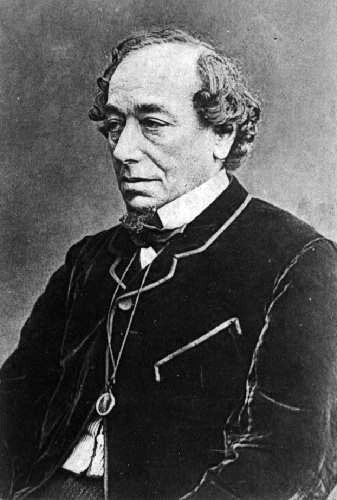
Benjamin Disraeli Citations
Benjamin Disraeli: Citations en anglais
“You know who critics are?— the men who have failed in literature and art.”
Source: Books, Coningsby (1844), Lothair (1870), Ch. 35. Compare: "Reviewers are usually people who would have been poets, historians, biographers, if they could; they have tried their talents at one or the other, and have failed; therefore they turn critics", Samuel Taylor Coleridge, Lectures on Shakespeare and Milton, p. 36. Delivered 1811–1812; "Reviewers, with some rare exceptions, are a most stupid and malignant race. As a bankrupt thief turns thief-taker in despair, so an unsuccessful author turns critic", Percy Bysshe Shelley, Fragments of Adonais.
“The world is a wheel, and it will all come round right.”
Source: Books, Coningsby (1844), Endymion (1880), Ch. 70.
Lord George Bentinck: A Political Biography (1852), p. 496.
1850s
In response to a man who asked Disraeli "What is the difference between a misfortune and a calamity?" cited in Wilfrid Meynell, Benjamin Disraeli: An Unconventional Biography (1903), p. 146.
Sourced but undated
Source: Speech https://api.parliament.uk/historic-hansard/lords/1881/mar/04/candahar-resolution in the House of Lords (4 March 1881).
“The more you are talked about the less powerful you are.”
Source: Books, Coningsby (1844), Endymion (1880), Ch. 36.
“There is no index of character so sure as the voice.”
Bk. II, Ch. 1.
Books, Coningsby (1844), Tancred (1847)
“Nobody is forgotten, when it is convenient to remember him.”
Source: Letter to Lord Stanhope (17 July 1870), cited in William Flavelle Monypenny and George Earle Buckle, The Life of Benjamin Disraeli, Earl of Beaconsfield, Vol. 5 (1920), p. 123-125.
“Fear makes us feel our humanity.”
Book III, Chapter 6.
Books, Coningsby (1844), Vivian Grey (1826)
Source: Speech at Mansion House (7 August 1867), quoted in William Flavelle Monypenny and George Earle Buckle, The Life of Benjamin Disraeli, Earl of Beaconsfield. Volume II. 1860–1881 (London: John Murray, 1929), p. 287
Source: Speech of 9 November 1867.
“As for our majority… one is enough.”
Source: Books, Coningsby (1844), Endymion (1880), Ch. 64.
Source: Speech to the Conservatives of Manchester (3 April 1872), quoted in William Flavelle Monypenny and George Earle Buckle, The Life of Benjamin Disraeli, Earl of Beaconsfield. Volume II. 1860–1881 (London: John Murray, 1929), p. 531.
Source: Books, Coningsby (1844), Endymion (1880), Ch. 23.
“If you are not very clever, you should be conciliatory.”
Source: Books, Coningsby (1844), Endymion (1880), Ch. 85.
“London is a roost for every bird.”
Source: Books, Coningsby (1844), Lothair (1870), Ch. 11.
Source: Books, Coningsby (1844), Lothair (1870), Ch. 29.
Book V, Chapter 6.
Books, Coningsby (1844), The Young Duke (1831)
“Debt is the prolific mother of folly and of crime.”
Book 2, chapter 1.
Books, Coningsby (1844), Henrietta Temple (1837)
Bk. III, Ch. 4.
Books, Coningsby (1844), Tancred (1847)
“A majority is always the best repartee.”
Bk. II, Ch. 1.
Books, Coningsby (1844), Tancred (1847)
Speech http://hansard.millbanksystems.com/commons/1849/feb/01/address-in-answer-to-the-speech in the House of Commons (1 February 1849). <br class="br">1840s
Speech http://hansard.millbanksystems.com/commons/1850/may/14/foreign-corn in the House of Commons (14 May 1850). <br class="br">1850s
“The world is weary of statesmen whom democracy has degraded into politicians.”
Source: Books, Coningsby (1844), Lothair (1870), Ch. 17.
Source: Speech in Aylesbury (14 November 1861), quoted in William Flavelle Monypenny and George Earle Buckle, The Life of Benjamin Disraeli, Earl of Beaconsfield. Volume II. 1860–1881 (London: John Murray, 1929), p. 96
“He seems to think that posterity is a pack-horse, always ready to be loaded.”
Speech in the House of Commons (3 June 1862)
1860s
“Every man has a right to be conceited until he is successful.”
The 'Advertisement' to the 1853 edition.
Books, Coningsby (1844), The Young Duke (1831)
“There is moderation even in excess.”
Book VI, Chapter 1.
Books, Coningsby (1844), Vivian Grey (1826)
“We are indeed a nation of shopkeepers.”
Book I, Chapter 11.
Books, Coningsby (1844), The Young Duke (1831)
Source: Speech http://hansard.millbanksystems.com/commons/1873/mar/11/second-reading-adjourned-debate in the House of Commons (11 March 1873).


