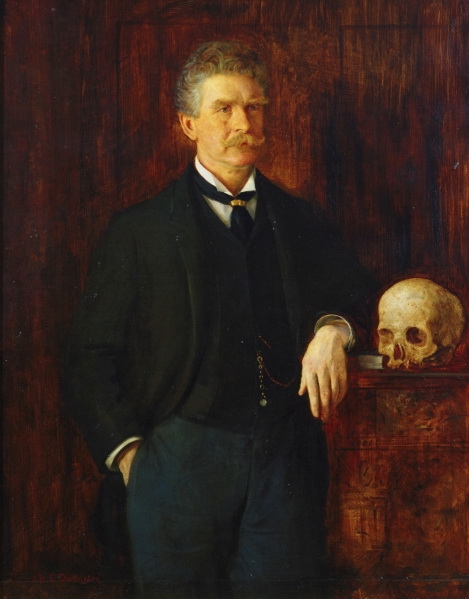
Issue du Dictionnaire du diable
Ambrose Bierce: 219 citations0 J'aime
Ambrose Bierce citations célèbres
“Abstinent : personne faible qui cède à la tentation de se refuser un plaisir.”
Issue du Dictionnaire du diable
“Présidence : le cochon le plus gras du champ de la politique.”
Issue du Dictionnaire du diable
“Patience : forme mineure de désespoir, déguisée en vertu.”
Issue du Dictionnaire du diable
“Tableaux : représentations en deux dimensions des choses inintéressantes en trois.”
Issue du Dictionnaire du diable
Ambrose Bierce Citations
“Immigrant : individu mal informé qui pense qu'un pays est meilleur qu'un autre.”
Issue du Dictionnaire du diable
“Politesse : forme la plus acceptable de l'hypocrisie.”
Issue du Dictionnaire du diable
“Irréfléchi : insensible à la valeur de votre conseil.”
Issue du Dictionnaire du diable
“Égoïste : une personne de mauvais goût, plus intéressée à elle-même qu'à moi.”
Issue du Dictionnaire du diable
“Bien-être : état d'esprit produit par la contemplation des ennuis d'autrui.”
Issue du Dictionnaire du diable
Ambrose Bierce: Citations en anglais
The Devil's Dictionary (1911)
Source: The Unabridged Devil's Dictionary
Contexte: Cartesian, adj. Relating to Descartes, a famous philosopher, author of the celebrated dictum, Cogito ergo sum -- whereby he was pleased to suppose he demonstrated the reality of human existence. The dictum might be improved, however, thus: Cogito cogito ergo cogito sum -- "I think that I think, therefore I think that I am;" as close an approach to certainty as any philosopher has yet made.
“Positive, adj. Mistaken at the top of one's voice.”
The Devil's Dictionary (1911)
Source: The Unabridged Devil's Dictionary
“FIDELITY, n. A virtue peculiar to those who are about to be betrayed.”
Source: The Unabridged Devil's Dictionary
“Inhumanity, n. One of the signal and characteristic qualities of humanity.”
Source: The Unabridged Devil's Dictionary
“Religion, n. A daughter of Hope and Fear, explaining to Ignorance the nature of the Unknowable.”
The Devil's Dictionary (1911)
Source: The Unabridged Devil's Dictionary
Ambrose Bierce livre The Devil's Dictionary
Source: The Devil's Dictionary (1911)
Contexte: Christian, n. One who believes that the New Testament is a divinely inspired book admirably suited to the spiritual needs of his neighbor. One who follows the teachings of Christ so long as they are not inconsistent with a life of sin.
Ambrose Bierce livre The Devil's Dictionary
The Devil's Dictionary (1911)
Source: The Unabridged Devil's Dictionary
“Philosophy, n. A route of many roads leading from nowhere to nothing.”
The Devil's Dictionary (1911)
Source: The Devil's Dictionary and Other Works
Ambrose Bierce livre The Devil's Dictionary
The Devil's Dictionary (1911)
“Admiration, n. Our polite recognition of another's resemblance to ourselves.”
Ambrose Bierce livre The Devil's Dictionary
The Devil's Dictionary (1911)
“Mayonnaise, n. One of the sauces that serve the French in place of a state religion.”
Ambrose Bierce livre The Devil's Dictionary
The Devil's Dictionary (1911)
“Happiness, n. An agreeable sensation arising from contemplating the misery of another.”
Ambrose Bierce livre The Devil's Dictionary
The Devil's Dictionary (1911)
Source: The Unabridged Devil's Dictionary
“Politics, n. Strife of interests masquerading as a contest of principles.”
Ambrose Bierce livre The Devil's Dictionary
The Devil's Dictionary (1911)
Contexte: Politics, n. A strife of interests masquerading as a contest of principles. The conduct of public affairs for private advantage.
“Impiety, n. Your irreverence toward my deity.”
Ambrose Bierce livre The Devil's Dictionary
Source: The Devil's Dictionary
“Amnesty, n. The state’s magnaminity to those offenders whom it would be too expensive to punish.”
The Devil's Dictionary (1911)
Source: The Unabridged Devil's Dictionary
Source: The Unabridged Devil's Dictionary
“War is God's way of teaching Americans geography.”
"War Is God's Way of Teaching Us Geography" https://quoteinvestigator.com/2014/05/19/geography/ at Quote Investigator <br class="br">"The comment 'War is God's way of teaching Americans geography,' is continually attributed to Ambrose Bierce. Biographer David E. Schultz, who has nearly all of Bierce's writing entered on his computer, cannot find this acerbic remark within that database." Ralph Keyes, The Quote Verifier (2007), p. 240 <br class="br">Misattributed
“Self-evident, adj. Evident to one's self and to nobody else.”
Ambrose Bierce livre The Devil's Dictionary
Source: The Devil's Dictionary


