“Je suis un païen converti vivant au milieu de puritains apostats.”
en
Surpris par la joie (Surprised by Joy, 1955)
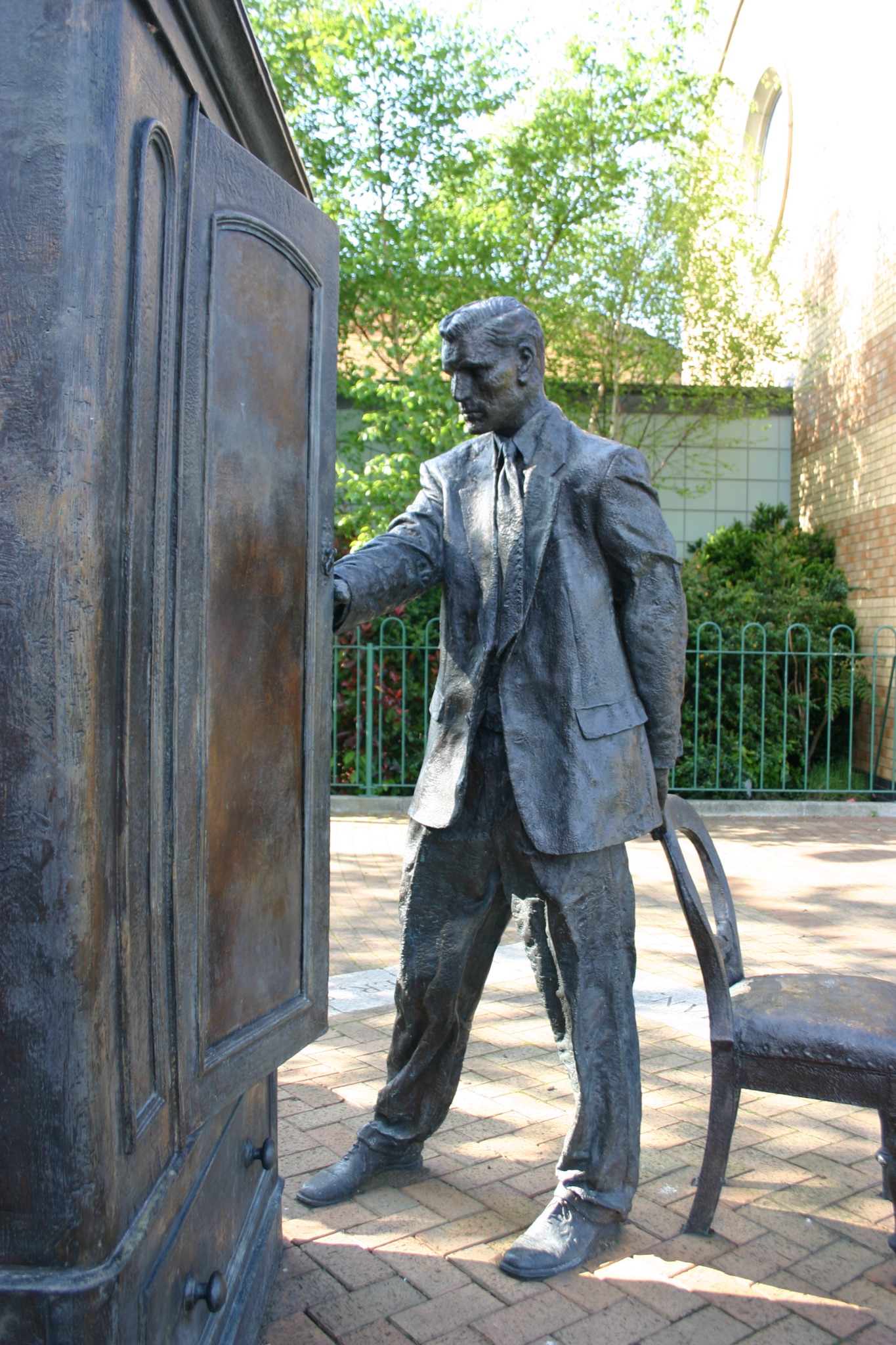
Clive Staples Lewis, plus connu sous le nom de C. S. Lewis, né à Belfast le 29 novembre 1898 et mort à Oxford le 22 novembre 1963, est un écrivain et universitaire britannique. Il est connu pour ses travaux sur la littérature médiévale, ses ouvrages de critique littéraire et d'apologétique du christianisme, ainsi que pour la série des Chroniques de Narnia parues entre 1950 et 1957.
Ami très proche de J. R. R. Tolkien, l'auteur du Seigneur des anneaux, il enseigne à ses côtés à la faculté de littérature anglaise de l'université d'Oxford ; ils faisaient tous deux partie du cercle littéraire des Inklings. Partiellement en raison de l'influence de Tolkien et de la lecture de G. K. Chesterton, Lewis s'est reconverti au christianisme, devenant, selon ses propres termes, « un très ordinaire laïc de l'Église d'Angleterre » ; cette reconversion a eu de profondes conséquences sur son œuvre. Il a acquis une grande popularité par les chroniques radiophoniques sur le christianisme qu'il a données au cours de la Seconde Guerre mondiale et obtenu un énorme succès avec ses livres de fantasy pour enfants.
Les œuvres de C. S. Lewis ont été traduites en plus de 40 langues et le recueil des Chroniques de Narnia s'est vendu à plus de 120 millions d'exemplaires dans le monde et continue à se vendre au rythme de plus d'un million d'exemplaires par an. Le Monde de Narnia a également été adapté à plusieurs reprises au théâtre et au cinéma. Wikipedia
“Je suis un païen converti vivant au milieu de puritains apostats.”
en
Surpris par la joie (Surprised by Joy, 1955)
“Integrity is doing the right thing, even when no one is watching.”
Not found in Lewis's works. <br class="br">"Integrity means doing the right thing at all times, without hesitation" is found in a 1943 syndicated newspaper column. Elsie Robinson, "Listen, World!" https://www.newspapers.com/newspage/58360960/, Evening News (Harrisburg, PA), 1943-02-24, p. 10. <br class="br">"Integrity means doing the right thing even when no one is there to judge" is found (unattributed) in the 1965 Journal of Clinical Psychology https://books.google.com/books?id=9rm1AAAAIAAJ&dq=%22integrity%22+%22doing+the+right+thing%22&focus=searchwithinvolume&q=%22doing+the+right+thing%22. <br class="br">The quote became attributed to C.S. Lewis by 2012 https://books.google.com/books?id=XH-1TURLaf4C&pg=PT154&dq=integrity+%22even+when%22+%22c+s+lewis%22&hl=en&sa=X&ved=0ahUKEwi6x9XznoTKAhUKymMKHdoKCKoQ6AEIHTAA#v=onepage&q=integrity%20%22even%20when%22%20%22c%20s%20lewis%22&f=false. <br class="br">Misattributed
“Eating and reading are two pleasures that combine admirably.”
Clive Staples Lewis livre Surprised by Joy
Surprised by Joy (1955)
Clive Staples Lewis livre The Pilgrim's Regress
Pilgrim’s Regress 117
The Pilgrim's Regress (1933)
Clive Staples Lewis livre God in the Dock
"Miracles" (1942), p. 29
God in the Dock (1970)
“Try now to answer my third riddle. By what rule to you tell a copy from an original?”
Clive Staples Lewis livre The Pilgrim's Regress
Pilgrim’s Regress 52
The Pilgrim's Regress (1933)
The World's Last Night (1952)
“I can't imagine a man really enjoying a book and reading it only once.”
Letter to Arthur Greeves (February 1932) — in They Stand Together: The Letters of C. S. Lewis to Arthur Greeves (1914–1963) (1979), p. 439
Clive Staples Lewis livre The Screwtape Letters
Letter XXI
The Screwtape Letters (1942)
“You are never too old to set another goal, or to dream a new dream.”
Unknown, but also attributed to Les Brown, a motivational speaker. Commonly attributed to C.S. Lewis, but never with a primary source listed.
Misattributed
"Bulverism" (1941)
Clive Staples Lewis livre That Hideous Strength
Source: That Hideous Strength (1945), Ch. 7 : The Pendragon, section 2
Clive Staples Lewis livre The Abolition of Man
The Abolition of Man (1943)
Clive Staples Lewis livre God in the Dock
"Christian Apologetics" (1945), p. 92
God in the Dock (1970)
Clive Staples Lewis livre Miracles
Source: Miracles (1947), Ch. 7: "A Chapter of Red Herrings"
Clive Staples Lewis livre The Great Divorce
I cried. 'I am caught by the morning and I am a ghost.'
Source: The Great Divorce (1944–1945), Ch. 14
“You don’t have a soul. You are a soul. You have a body.”
Commonly attributed to Mere Christianity, where it is not found. Earliest reference seems to be an unsourced attribution to George MacDonald in an 1892 issue of the Quaker periodical The British Friend.
Misattributed
Variante: You don’t have a soul. You are a soul. You have a body.
Clive Staples Lewis livre Mere Christianity
Book II, Chapter 5, "The Practical Conclusion"
Mere Christianity (1952)
The World's Last Night (1952)
Clive Staples Lewis livre The Screwtape Letters
Letter XIV
The Screwtape Letters (1942)
Clive Staples Lewis livre Surprised by Joy
Surprised by Joy (1955)
“Courtship is the time for sowing those seeds which will grow up ten years into domestic hatred.”
Clive Staples Lewis livre The Screwtape Letters
Letter XXVI
The Screwtape Letters (1942)
Clive Staples Lewis livre Mere Christianity
Book III, Chapter 4, "Morality and Psychoanalysis"
Mere Christianity (1952)
Clive Staples Lewis livre Mere Christianity
Book IV, Chapter 9, "Counting the Cost"
Mere Christianity (1952)
Clive Staples Lewis livre Surprised by Joy
Surprised by Joy (1955)
Clive Staples Lewis livre Mere Christianity
Book III, Chapter 6, "Christian Marriage"
Mere Christianity (1952)
Clive Staples Lewis livre The Pilgrim's Regress
Pilgrim’s Regress 89
The Pilgrim's Regress (1933)
“Reality is harsh to the feet of shadows.”
Clive Staples Lewis livre The Great Divorce
Source: The Great Divorce (1944–1945), Ch. 5
Clive Staples Lewis livre The Problem of Pain
The Problem of Pain (1940)
Variante: "Atheists express their rage against God although in their view He does not exist."
“There was a boy called Eustace Clarence Scrubb, and he almost deserved it.”
Clive Staples Lewis The Chronicles of Narnia
The Voyage of the Dawn Treader (1952), Ch. 1
The Chronicles of Narnia (1950–1956)


