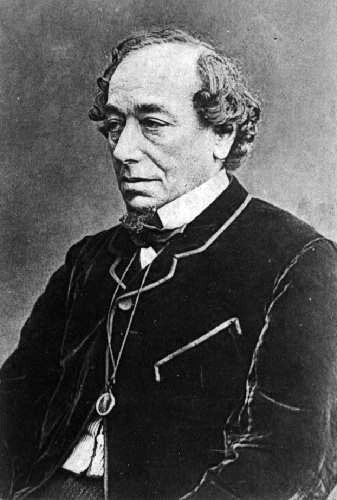
Benjamin Disraeli citations
Page 9

Benjamin Disraeli, né le 21 décembre 1804 et mort le 19 avril 1881 à Londres, est un homme d'État et écrivain britannique, Premier ministre du Royaume-Uni à deux reprises. Il joue un rôle central dans la création du Parti conservateur moderne dont il formalise la doctrine. Par sa grande influence sur la politique étrangère, il a associé les conservateurs à la gloire et à la puissance de l'Empire britannique.

Né dans une famille juive, Benjamin Disraeli est élevé dans la foi anglicane car son père est en conflit avec sa synagogue. Il entame une carrière d'avocat mais se tourne vers la politique dans les années 1830 et est élu à la Chambre des communes comme député de Maidstone en 1837. Lorsque les conservateurs prennent le pouvoir en 1841, Disraeli n’intègre pas le gouvernement du Premier ministre Robert Peel. Cinq ans plus tard, Peel divise le parti en demandant l'abrogation des Corn Laws qui limitaient les importations de céréales : il est violemment attaqué par Disraeli. Peu de notables conservateurs rompent avec Peel, et Disraeli devient alors une figure importante du parti même si beaucoup se méfient de lui. Il est trois fois chancelier de l'Échiquier et chef de la Chambre des communes au sein des cabinets de Lord Derby dans les années 1850 et 1860. Il développe à cette période une forte rivalité avec le libéral William Ewart Gladstone.

Lorsque Derby démissionne pour des raisons de santé en février 1868, Disraeli devient Premier ministre mais perd les élections à la fin de l'année. Il représente alors l'Opposition avant de mener son parti à la victoire en 1874. Il développe une forte amitié avec la reine Victoria qui le fait comte de Beaconsfield en 1876. Le second mandat de Disraeli est dominé par la question d'Orient, désignant le déclin de l'Empire ottoman et les actions des autres pays européens, notamment la Russie, pour en profiter. Il pousse ainsi les intérêts britanniques à prendre des parts dans la compagnie du canal de Suez en Égypte ottomane. En 1878, devant les victoires russes contre les Ottomans, Disraeli mène la délégation britannique au congrès de Berlin et négocie des termes favorables au Royaume-Uni.

Même si Disraeli est félicité pour ses actions à Berlin, d'autres événements affectent le soutien à son gouvernement : les guerres en Afghanistan et en Afrique du Sud sont critiquées, et il irrite les agriculteurs britanniques en refusant de rétablir les Corn Laws. Gladstone mène une campagne efficace et le parti libéral remporte les élections de 1880.

Auteur de plusieurs romans depuis 1826, Benjamin Disraeli publie sa dernière œuvre, Endymion, peu avant sa mort à l'âge de 76 ans. Wikipedia  

✵ 21. décembre 1804 – 19. avril 1881
Benjamin Disraeli photo
Benjamin Disraeli: 307 citations0 J'aime

Benjamin Disraeli Citations

Benjamin Disraeli: Citations en anglais

“Without tact you can learn nothing.”

Benjamin Disraeli

Source: Books, Coningsby (1844), Endymion (1880), Ch. 61.

“The sweet simplicity of the three per cents.”

Benjamin Disraeli

Source: Books, Coningsby (1844), Endymion (1880), Ch. 96. Compare: "The elegant simplicity of the three per cents", Lord Stowell, in Lives of the Lord Chancellors (Campbell), Vol. x, Chap. 212.

“A very remarkable people the Zulus: they defeat our generals, they convert our bishops, they have settled the fate of a great European dynasty.”

Benjamin Disraeli

Source: Upon hearing of the death of Napoléon, Prince Imperial of the House of Bonaparte in Africa (1879); cited in James Anthony Froude, Lord Beaconsfield (1890), p. 213.

“None are so interested in maintaining the institutions of the country as the working classes. The rich and the powerful will not find much difficulty under any circumstances in maintaining their rights, but the privileges of the people can only be defended and secured by popular institutions.”

Benjamin Disraeli

Source: Letter to a working men's club (1867), quoted in William Flavelle Monypenny and George Earle Buckle, The Life of Benjamin Disraeli, Earl of Beaconsfield. Volume II. 1860–1881 (London: John Murray, 1929), p. 297.

“He is so vain that he wants to figure in history as the settler of all the great questions; but a Parliamentary constitution is not favorable to such ambitions; things must be done by parties, not by persons using parties as tools.”

Benjamin Disraeli

Source: Letter to Lord John Manners, referring to the tactics of Prime Minister Sir Robert Peel (17 December 1846), cited in William Flavelle Monypenny and George Earle Buckle, The Life of Benjamin Disraeli, Earl of Beaconsfield (Vol. 2) (1913), p. 337-338.

“Candour is the brightest gem of criticism.”

Benjamin Disraeli

Isaac D'Israeli, The Curiosities of Literature, "Literary Journals".
Misattributed, Isaac D'Israeli

“In politics nothing is contemptible.”

Benjamin Disraeli

Book VI, Chapter 4.
Books, Coningsby (1844), Vivian Grey (1826)

“But this principle of race is unfortunately one of the reasons why I fear war may always exist; because race implies difference, difference implies superiority, and superiority leads to predominance.”

Benjamin Disraeli

Speech http://hansard.millbanksystems.com/commons/1849/feb/01/address-in-answer-to-the-speech in the House of Commons (1 February 1849). <br class="br">1840s

“The sense of existence is the greatest happiness.”

Benjamin Disraeli

Part 3, Chapter 1.
Books, Coningsby (1844), Contarini Fleming (1832)

“He was fresh and full of faith that "something would turn up."”

Benjamin Disraeli

Bk. III, Ch. 6.
Books, Coningsby (1844), Tancred (1847)

“When little is done, little is said; silence is the mother of truth.”

Benjamin Disraeli

Bk. IV, Ch. 4.
Books, Coningsby (1844), Tancred (1847)

“Protection is not a principle, but an expedient.”

Benjamin Disraeli

Speech http://hansard.millbanksystems.com/commons/1845/mar/17/agricultural-interest in the House of Commons (17 March 1845). <br class="br">1840s

“Before the civil war commenced, the United States of America were colonies, and we should not forget that such communities do not cease to be colonies because they are independent.”

Benjamin Disraeli

Source: Speech http://hansard.millbanksystems.com/commons/1863/feb/05/address-to-her-majesty-on-the-lords in the House of Commons (5 February 1863).

“Yes, I am a Jew, and when the ancestors of the right honourable gentleman were brutal savages in an unknown island, mine were priests in the temple of Solomon.”

Benjamin Disraeli

1830s <br class="br">Variante: Yes, I am a Jew, and when the ancestors of the right honorable gentleman were brutal savages in an unknown island, mine were priests in the temple of Solomon <br class="br">Source: Reply to a taunt by Daniel O&#x27;Connell http://www.victorianweb.org/history/pms/dizzy.html <br class="br">Source: Early appearance in The Russian Mephistopheles, Hunterberg, Max, 105-106, 1909, Glasgow, John J. Rae https://archive.org/details/russianmephistop00huntiala/page/106/mode/2up,

“Where knowledge ends, religion begins.”

Benjamin Disraeli

Remark, attributed in John Gordon Stewart Drysdale and John James Drysdale, The Protoplasmic Theory of Life (1874), p. 279 (note).
Sourced but undated

“I say, then, assuming, as I have given you reason to assume, that the price of wheat, when this system is established, ranges in England at 35s. per quarter, and other grain in proportion, this is not a question of rent, but it is a question of displacing the labour of England that produces corn, in order, on an extensive and even universal scale, to permit the entrance into this country of foreign corn produced by foreign labour. Will that displaced labour find new employment? … But what are the resources of this kind of industry to employ and support the people, supposing the great depression in agricultural produce occur which is feared—that this great revolution, as it has appropriately been called, takes place—that we cease to be an agricultural people—what are the resources that would furnish employment to two-thirds of the subverted agricultural population—in fact, from 3,500,000 to 4,000,000 of people? Assume that the workshop of the world principle is carried into effect—assume that the attempt is made to maintain your system, both financial and domestic, on the resources of the cotton trade—assume that, in spite of hostile tariffs, that already gigantic industry is doubled…you would only find increased employment for 300,000 of your population…What must be the consequence? I think we have pretty good grounds for anticipating social misery and political disaster.”

Benjamin Disraeli

Speech http://hansard.millbanksystems.com/commons/1846/may/15/corn-importation-bill-adjourned-debate in the House of Commons (15 May 1846). <br class="br">1840s

“To govern men, you must either excel them in their accomplishments, or despise them.”

Benjamin Disraeli

Letter to his father from Malta (25 August 1830), cited in Lord Beaconsfield's Letters, 1830-1852 (1882), p. 32
1830s

“We should never lose an occasion. Opportunity is more powerful even than conquerors and prophets.”

Benjamin Disraeli livre Tancred

Tancred, Chapter 46.
Books, Coningsby (1844), Tancred (1847)

“At present the peace of the world has been preserved, not by statesmen, but by capitalists.”

Benjamin Disraeli

Source: Letter to Mrs. Sarah Brydges Willyams (17 October 1863), quoted in William Flavelle Monypenny and George Earle Buckle, The Life of Benjamin Disraeli, Earl of Beaconsfield. Volume II. 1860&ndash;1881 (London: John Murray, 1929), p. 73

“Everyone likes flattery, and when you come to Royalty you should lay it on with a trowel.”

Benjamin Disraeli

In a letter to Matthew Arnold, as quoted in Stanley Weintraub, Victoria. Biography of a queen (1987), p. 412.
Sourced but undated

“A man's fate is his own temper.”

Benjamin Disraeli

Book VI, Chapter 7.
Books, Coningsby (1844), Vivian Grey (1826)

“Seeing much, suffering much, and studying much, are the three pillars of learning.”

Benjamin Disraeli

A Welsh triad cited in A Vindication of the Genuineness of the Ancient British Poems of Aneurin, Taliesin, Llywarch Hen, and Merdin (1803), by Sharon Turner, reads, "The three pillars of learning; seeing much, suffering much, and studying much". This was quoted from Turner by Isaac D'Israeli in his The Amenities of Literature (1841) and, through the confusion of father with son, has come to be falsely attributed to Benjamin Disraeli.
Misattributed

“If it is not necessary to change, it is necessary not to change.”

Benjamin Disraeli

Attributed to Edmund Burke, to William Gerard Hamilton, to George Bernard Shaw, to John F. Kennedy (who quoted it) and to Benjamin Disraeli, it was actually said by Lucius Cary, 2nd Viscount Falkland in a speech in the House of Commons on 1641-11-22.
Misattributed

“Without publicity there can be no public spirit, and without public spirit every nation must decay.”

Benjamin Disraeli

Source: Speech http://hansard.millbanksystems.com/commons/1871/aug/08/third-reading in the House of Commons (8 August 1871).

Auteurs similaires

Lewis Carroll photo
Lewis Carroll4
romancier, essayiste, photographe et mathématicien britanni… None
Emily Brontë photo
Emily Brontë18
écrivaine britannique None
George Sand photo
George Sand75
romancière et dramaturge française None
Thomas Carlyle photo
Thomas Carlyle1
Romancier, historien et essayiste écossais None
Jane Austen photo
Jane Austen23
romancière anglaise None
Jules Verne photo
Jules Verne55
romancier français None
Émile Zola photo
Émile Zola69
romancier, auteur dramatique, critique artistique et littér… None
Honoré de Balzac photo
Honoré de Balzac193
romancier, critique littéraire, essayiste, journaliste et é… None
Victor Hugo photo
Victor Hugo322
écrivain français None
Mark Twain photo
Mark Twain23
romancier, journaliste et humoriste américain None